
Leather cleaning
The starting point for every restoration. On dirty leather no colour or protector will hold.
Services Leather treatments
With long use, leather turns shiny where it is touched. De-glossing brings back its factory matt look.
Leather that gets touched turns shiny over time. The shine comes from fabrics and hands polishing the grain — fastest on the seat bolsters, armrests and headrest. The effect is distinctive: shiny patches against a matt background, which make the interior look worn even when the colour is still good.
The second case is leather after a failed restoration, finished with too glossy a coating. It then looks artificial, however well the rest was done.
Polished grain can't always be brought back by de-glossing alone — if the grain has been worn smooth, it has to be recreated, and that is a job involving filling and re-colouring.
We match the level of matt to the original. Factory interiors are rarely completely matt; overdone matt looks just as unnatural as overdone gloss.
The starting point for every restoration. On dirty leather no colour or protector will hold.
Leather exposed to the sun goes stiff — fastest of all in a car. Softening brings back its suppleness before it starts to crack.
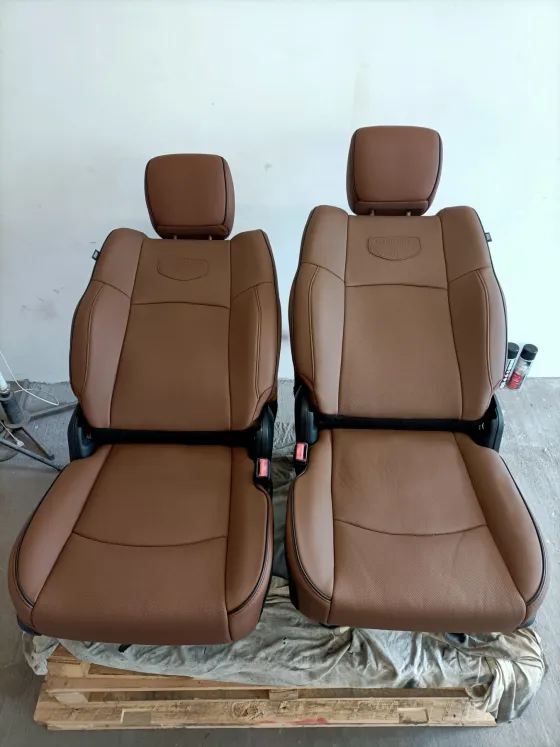
Colours matched to the type of leather: one kind for pigmented car upholstery, another for aniline and semi-aniline furniture leather.
Evening out the shade on worn areas, or changing the colour of the whole thing.
Products that protect against UV, water and denim dye transfer — the most common cause of stains on light-coloured seats.
Split seams, lifting edges, cracks at the folds.
The quickest way is this: a photo of the whole item, a close-up of the damage and a note on what the item or part is. On that basis we'll tell you whether it can be saved and what it will cost.
We use cookies so that the site works and so that we know which content is useful. Statistics are on by default — under “Customise” you can switch them off and the site will work just the same.
Privacy policy →Required for the site to work at all: remembering your choice in this window and the admin panel session. They cannot be switched off.
nbd_zgody | 1 year | your cookie choice |
nbd_admin | until the browser is closed | admin panel session (staff only) |
nbd_dev | 60 days | remembered admin panel device (staff only) |
They help us understand how visitors use the site — which pages they read and where they come from. Collected anonymously.
_ga | 2 years | Google Analytics — distinguishing users |
_ga_* | 2 years | Google Analytics — session state |